Mostrando entradas con la etiqueta Entrevista. Mostrar todas las entradas

Ah! Magazine- interview/ entrevista

Entrevista a LRM Locus,
 por Irene Calvo para Ah!  magazine 
Interview for Ah! magazine by Irene Calvo

Irene Calvo nos ha hecho esta fantástica entrevista para
 Ah Magazine en la que hablamos de Kowloon y de todo el proceso que hemos desarrollado este año y medio en el estudio.


This is a wonderful interview about the creative process in our workspace for Kowloon through this last year. We thank Irene Calvo for it.
Here you have the english translation: 


The place, the weathering, the moment, the performance


LRM ( "Locus", Rodo, Momentum or Place, Scraping, Time) is a group from Madrid focused on performance art. They define their works as abstract avoiding any narrative thread in their creations, where we can find music, light, dance and projections. Transdisciplinary performances that will not leave you indifferent.


IRENE - Who are LRM Performance- Locus and how did the project come about?

Berta - David and I are the core of the collective. David comes from the world of musical composition, is MA in composition and I am an MA in Fine Arts. We met fifteen years ago at a Ute Lemper concert. We were interested in many artistic aspects, such as multidisciplinary work and we had many common references. Then we started making short  musical improvisations with live digital media and physical painting; we also created some short video art pieces ... and thus our way of working was forged. We did some presentations of these works, for example in Matadero Madrid; the format was kind of a concert, we were sitting in a chair with the computer and two screens behind us.

David - Those first performances with prepared piano and painting improvisations happened in 2004 and then we had not a name yet. When we presented in Matadero In 2007 the piece was titled "Lugar, Roce, Momento (Place, Abrading, Moment), hence "LRM". In fact, in that piece already included movement, light, and overhead projections.

In 2008 we worked with a dance performer for the the first time. By then we had already increased the size of the pieces, combining lights and video and mixing them with music and movement. From that moment on we always work with a dance performer.

B- … we always work in three dimensions: devising the piece from a sound, visual and movement plus spatial standpoint. 
D- Someone recently told us we are "anti-disciplinary" rather than interdisciplinary; for we are not interested visual arts, music and movement alone, we are interested in a discipline that is none of these but contains all of them, because if it doesn't, we get bored [laughs]

I- With what aims or needs does LRM come about?
B- With the need to learn, because every time we get into the studio it becomes a laboratory to try out everything at once: sound plus a structure, lighting, how to move with such structure, how we move ourselves in space ... it is an ongoing learning process and we build on those new learnings in every new piece. For example, when designing structures for composing a piece - which is usually made up of short scenes and each one has a particularity-.... there it is this need to discover, to learn. Presenting the piece is another kind of task altogether.
D- It also has to do with the fact of feeling trapped within your own discipline I think, the one you studied, for those are endogamic worlds. We have a craving for seeing what is on the other side, what is in there. In this sense, we somewhat like the total idea of cinema, bringing together all the elements, perhaps we are after something like live cinema.

¿I- What are your influences?
B- We like Taiwanese director Tsai Ming-Liang. He has a very abstract cinematographic work. He works from scenes sometimes with a small plot, but not always fully narrative, some actions apparently have no meaning. We are struck by the way he composes the frame; the character enters and leaves the room but the framing is fixed. It is very contemplative.
Moreover, Apichatpong Weerasethakul from Thailand also makes a quite abstract kind of films, closely related to nature, where things take their time to happen. There is no such overwhelming directionality we find in Western movies, where the camera pushes the observer into pursuing the character's direction. This type of asian cinema does not have that directionality, the way they compose the image and its relationship with the character is important, but so is the environment, light, the temporality ... There is none of that western pressure for something to occur, Asian arthouse films do not consider that problem.
Regarding colour we are interested in japanese anime, for example Koji Morimoto
D- The perception of color in Asia is quite different from the West, it becomes evident in japanese Ukiyo-e prints, chinese opera, or traditional dances of Thailand. Also in many other cultures, like sub-saharan african colour and rhythm concepts which are very interesting.

I- You have many Asian influences, but any European or Western?
B- We do, simply by living here we already have such influences. In this our latest work we had so much in mind Into Eternity (2010) a Michael Madsen documentary filmed in Finland about "Onkalo", a nuclear repository with kilometers of underground tunnels to store nuclear waste.
D -  … we are quite excited about the work of Swedish film director Roy Andersson, his style is quite different to ours, a little more narrative, but it's still pretty abstract. And we can not deny we have a lot of influence of Goya, specifically his black paintings. We also got inspired by New York artist Gordon Matta-Clark (1943-1978) and his treatment of light in his works. Or Andrej Tarkovsky (1932-1986) films, like Stalker (1979). About dance, we were amazed by the work of british dance company DV8 and also by Legend Lin Dance Theatre, (which is not european but taiwanese).

I- Why did you decide to include light, sound and other elements into your works?
D- guess we always regarded the video projector as some device emitting light rather than film. We then decided to buy an overhead projector and found it very interesting to work with shadows.
B- Light defines figures, volumes and space. Light and darkness are equally important to us. In darkness we set up what you will see later and the idea of light / shadow helped us a lot when devising each scene in time. Light is an important recourse to integrate a human figure because we do not want it to become too important, we want to merge it with the scene. It is a recourse for bringing public attention into the illuminated part, a way of composing. It is the remnants of painting in our work, in fact, some scenes become utterly pictorial.
D- Darkness is our blank canvas. But (for me) the most interesting thing about light is that it is temporary, so usually it goes along with music.

I- How does this sound part of the work is created along with light changes, scenes ...?
D- by accumulating material and later in the studio assembling one thing with the other. Sometimes we start with a sound and want to do something with it, so we begin to try it with lights; sometimes even the sound demands for certain colorus, somewhat like synesthesia. Sometimes we have an already lit scene and add sound. Our procedures for devising each scene are diverse. 


I- How is your creative process?
B- It normally starts by thinking about structures built on bars, fastened with pins, using materials such as cloth, paper, plastic; considering how to light it up, what kind of bodily relationship we have with the structure, what movements are emerging around it ... At the same time we improvise with sounds or music David composed. We record many different tryouts. After a year and a half, as it was the case with the latest work, we end up with hundreds of tests. among these, we choose those we liked and from that selection we make a final sorting out, based on whether it is feasible to group them and perform them in succession, since it will be necessary for a scene's structure to be moved over for the next scene, and you have to see how to join scenes together. And thus an internal coherence of the work emerges. We love to have people over to the studio to see our work and hear what they think. If all visitors draw a similar conclusion, we often change elements in the work in order to make it more non-narrative. It is a task that goes beyond the investigation period.
D -Something we've always wanted to from the beginning is doing nothing narrative or conceptual. We think that is already tired. We want to do something that is telling no story, or that it's story lies inside each person's mind. We like our audience to use their imagination.
B- There is some fear for open works, for instance in cultural institutions… when presenting our work, we must indicate a topic, check a box ... That dictates much of people's works.
Also, when we comprise so many different elements into each action, most individuals coming from certain 1960's type of performance art find our work terrible. They (hypocritically) regard the usage of multiple light and sound elements as "selling out". 

I- Is there a heavy legacy of 60-70s performance art?
B- Yes. I think it's a problem in Spain, because here Performance art means performance as is was done in the sixties –a particular kind of performance art…and then you investigate a bit and learn there was a lot of people doing many different things in the sixties, including music, light ... awesome stuff. In Italy, for example, they have a freer conception of performance art, almost scenic.

I- What condition is Spain's performance art in now?
D It is striking how performance art, coming from the 60s and seeking to be a liberation movement has stuck in the twentieth century; It has become intolerance instead of pluralism: a single criterion has been imposed. What is sought in it now is to "épater les bourgeois" -currently the gentrified-, with political support from institutions that are not precisely supporting the ideals those artists claim to defend, rather attacking them.
B- Performance art in Spain is always much associated to political issues or activism, usually improvised and with little toil, even if in its origin it was not necessarily that way. So when we say "this is also performance", some disagree because what we do is not a protesting, spontaneous or impromptu action.
D - We believe any political action must be done as a citizen, not as an artist, because the current situation invalidates any political discourse of a work; for example by the context in which it is exposed.

I- If there is something you have in common with this performance art from the 60's tht is the usage of the body.
B- Yes, but it is the body in a context. In such so-called "classic" performances it is usually naked, and we do the opposite: we put on layers and layers and deform the body, using prosthetics or masks, somewhat in line with the Triadic Ballet: regarding the body as a part of the composition.
D- I get the impression that the use of the naked body in an empty space of the stereotypical performance art ends up being quite narcissistic. In that sense we do integrate the body with light, color and the environment, which are as important as the person.

I- You say your performances are abstract and consisting of scenes. Did you ever fancy  telling a story?
B- No, but what really is more complicated is not telling any story. Especially since our components' gender, we currently are two women and a man, and just because of gender people tend to see relationships where there is actually nothing. We have to see how to run the entire set of stimuli (music, light and movement) not to provoke a clear general feeling in the audience, such as sadness or joy ... There must always be elements preventing a predominant sensation and that is very difficult. So we work in a very formal way. If we want to include a scene in which someone falls down, we have to think about what kind of sound we may use so that it is not recognisable whether it was good or wrong that he fell down. That's when your mind starts working as an audience.
D- To achieve this effect we do things like mixing the sound of an iceberg with recordings of rhinos while one of us appears dressed in something like a Samurai armor, dragging objects indefinitely ... is a crazy mix, but your brain will try to assemble all and look for consistency, and that is what we try to avoid. 

I- Do you have any difficulty exhibiting in galleries or art circuits?
B- not difficulty, pain [laughs]. Especially because there are many adverse circumstances. There are many people interested in presenting our work but willy-nilly they will not not pay for it. There are centres and large institutions holding the belief that live arts are not to be paid for, and we refuse to work without being paid. We have been working with great effort for over ten years already. If you do not get paid everything is devalued, not just our work but the whole art system. And this restricts the possibilities to continue creating. 
On the other hand, stylistically we must find someone who understands our work, which comprises several disciplines. We have been to art, music, theater, dance venues and festivals ... the best reception comes from non-specialists, generally audiences have no problem with us.
D- When dance people see our stuff, they say it is theater. When visual arts people see our stuff, they say it is dance. But when theatre people see it, they say it is not theater, rather visual art for them… We prepared our work so it can fit into any kind of space: auditorium, theater, art center ... for we have to be versatile. But in the end it depends on how open the programming or curating person is when deciding about giving us a spot or not.
B- Performance art is often regarded as a "pure" discipline that came from nowhere, although it usually feeds from the many sources available. Because we have many influences and there is nothing wrong in working from them. That's the problem. I think many times curators, programmers, etc., they need to get out of their so proudly closed world .

I- How long took you to put together the latest work? Tell us a little about it 
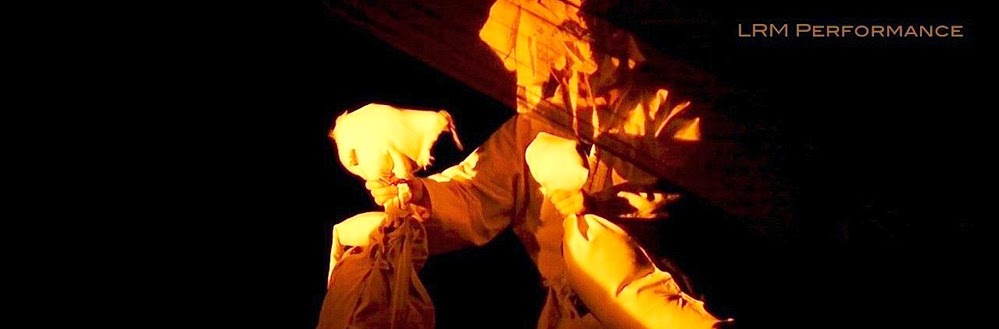
B- It's titled "Kowloon" and takes the name from a neighborhood of Hong Kong that interested us for its architecture. We had also seen a lot of films shot in that area in the 80s-90s. Certainly some of those influences from cinema and architecture are present but it is not a narrative or descriptive piece about Kowloon.
The difference from our previous work "Memory Root Light" is that it is much quieter and contemplative. We included new lighting colour, for before we only emplyed LED light, which provides a very specific range of  colour, but now we include incandescent lights, which give a warmer colour. The montage of the scenes is more cinematic, there are more "frame shifts" 
D.- is the first time we use no digital video projection.
B- No, we did not like how it looked like in this one, so we've worked hard with overhead and analog projectors customizing, transforming them, and we managed to coordinate their light with sound. In movement matters, we included more very slow motion, our previous work was much faster and could perhaps be perceived as more aggressive. We have further developed built structures that are now attached to the body, for before they were around.
D. - Also we included more natural sounds. We have sounds of Madrid, Hong Kong taxis, volcanoes ... used in a non narrative, not obvious way.  For example, for some scene cicadas –recorded last August in Madrid – are mingled with the sound of an Antarctic iceberg.

Do you contemplate video art as an option?
D- The problem is that what works live does not necessarily work in video, and this adaptation takes time. Actually, it is like making a new piece and you have to re-think it.
B- Now the main thing is to present the live work, then we will see other options.


I- What are your future plans?
B- traveling, meeting other environments and other artistic circles. We consider emigrating. Our previous piece could only be presented once in Spain, and looks like the same thing may happen with "Kowloon". So we have these two very elaborate works we would like to present, so to achieve this it seems to us we have to go abroad .
D- The art circuit in Spain is increasingly limited, the crisis has done much damage especially in terms of infrastructure, perhaps we were already worse off than other countries in Europe and that's why the crisis has been so catastrophic here in terms of artistic activity. In this regard we are considering searching for a market, find places where we may get a greater reception and a professional surrounding that is a little less closed in aesthetics.

I-  Finally, as usual, we ask you to recommend a book and a song to us… 
D- song ... well, I'd say the music I recommend is "Coming Together" by Frederic Rzewski. And a book, "Memoirs Found in a Bathtub" by Stanislav Lem.

B- My song, that is the piece I recommend is "The Rite of Spring" by Igor Stravinsky and a book, "The Art of Spirited Away" by Hayao Miyazaki.


Plastike Art Gallery: LRM Locus Interview / Entrevista


                    Plastiké Art Gallery a través de Ruth García realiza una entrevista a LRM Locus para su blog, 
puedes leerla en Castellano aquí

Plastiké Art Gallery via Ruth García interviews LRM Locus for their blog, 
 (Spanish version here )


CONTEMPORARY ART IN MOTION 

We Interviewed Berta Delgado and David Aladro-Vico, producers and directors of LRM Performance - Locus. 

Ruth García: LRM Locus results from simultaneously combining different arts (music, movement, visual and performing arts ...)  it is breaking from the traditional, the mixture of different artistic disciplines in favor of something new and especially of something quite personal. In short it is precisely the merger of two professional profiles coming from music and plastic arts.

 How were the beginnings of this ambitious project?

Berta: Our beginnings were simple, we did sound and visual improvisations; we realized both arts mutually reinforce. From there we decided to use and mix many more elements, from all kinds of backgrounds, because we enjoy so many different things. This forced us to a greater complexity, but in the end the ambition is the same as the start, just creating work as we ourselves would like to see it.


After watching your live staging, there is something different about this type of art…  could you disclose any secrets to us? 

David: Doing something different is very difficult, and knowing the secret of why, even more, but that's what the job is about, and possibly there lies its value, in that it is not easy to explain why. 
Berta: Maybe it's different because we transform elements without  letting their origin condition us, or because we do not  want to become "militant" in any particular art form or style.

Your body is an instrument of action, to paraphrase Henry Bergson ... You are the essential ingredients in this creative dish, each with a particular role.
Could you tell us a little more about  each one's role in Memory Root Light? 

David: We seek to escape from the narrative and conceptual, so we strive for the public not to be able to perceive a "role" or assign a meaning or function to each one. In that sense we get closer to what Bergson described as duration, as opposed to some erroneously mechanistic understanding which explains everything as action-reaction of elements (characters or concepts) that takes away the viewer's freedom to create their own vision or sense . To eliminate the "characters" and their "roles" is one of our greatest challenges. We keep working on it. 

Berta: In performance art thereis is much ado on the importance of the body, I guess that's a veiled reference to Viennese Actionism. Many current performers claim they prioritize body and do not care about light, sound, objects or their environment in general. 
Giving importance to the body only suggests a narcissistic rhetoric to us. It looks easy, almost commercial, and already tired. We've also seen it in dance and theater. 
We –in contrast to it – regard everything as equally important. The body and its actions are as important as the environment and all its elements. 
Because for the audience it also is. 

A unique experience ... LRM Performance is not a written story, each staging is unique, as is determined by many factors including material ones, in fact the sound of these, in some sense determine the flow of each action, set the pace of the work's motion itself. 
This is precisely what makes the project alive. 
How do you feel in each staging? Are you worried in any extent about the outcome? 

David: Yes, sound makes perceptible the relationship between time and space. In fact, sound is more effective for perceiving motion than light (i.e, attempting to synchronize with light instead of sound is much more difficult). We use a time line —that is, a score– , something that is at the origin of performance art, as for example in Cage and Cunningham or later in Esther Ferrer, -but few performers have it in mind today. 

Berta: Of course we do worry about the result, that's why we have the computer timeline controlling light, video and sound, and guiding our movement. There are some moments for improvisation, but we do control them, for not anything that comes up is useful to us. But what feelings arouse in those who see it, that we cannot control, so as in all creation, there is always a risk. If it were not so, it wouldn't be worth it. 

However, despite the absence of a script, we have seen that behind every project is a very thorough job, every element that is part of the action is perfectly designed, it all makes sense, nothing is random. In this sense, is it complicated to marry the pieces? 

Berta: Sure it is, it takes much longer to create, test, investigate. There are artists concerned with one thing only, whether visual, movement or sound, and the rest, either they leave it for someone else or they do not care.  That we think is a sign of sybaritic attitude, laziness or apathy in some cases. As I said before, addressing several fronts means you have to work harder. 


Following this, something that draws the attention of those who have had the pleasure to visit you in your Open Studio, is precisely getting to know step by step the creative process of this project, the research behind the sounds, materials and activities with which you form new realities. 

A Priori unconnected elements you nevertheless conform a puzzle with, where everything fits perfectly and this is precisely what the viewer sees. 
One cannot imagine that behind this surprising staging there is a mostly "manual" toil.  
But perhaps the most complex issue for you may be to determine the different contexts in which to place the performative action. 
What do you think about this?

David: That's right, we want to create a "context" – although an emotional or sensitive one rather than textual– but not to place into it an action; we may start from either an action or a light, from objects or sound, start either from one or from several at once. For us, everything is connected. There is no hierarchy, all are equally important. 

Berta: Yes, the labour is "manual", because the elements have to be manufactured or assembled, there's no choice if we want to be original. This applies to all objects, movements and sounds. 

We sometimes use any readymade object, after transforming it. We enjoy explaining things to our guests, but we are not interested in the public paying attention to the object's anecdote, that trend in recent years' plastic arts of using or serializing found or removed from context , we have already seen that too often. 

Something very interesting is the stories behind each item chosen. How to combine different stories within one story is the amazing result you have achieved with Memory Root Light.

Berta: as David suggested before, we create the work of art preventing the viewers from perceiving a thread or setting roles, nor give them a story or a concept or previous topic. It is very important to us that they do not have a closed mind about the work conditioning them and for them to have freedom to interpret their way. We want to escape from the conceptual way of understanding art,  for it seems easy and boring to us. 

David: It seems more respectful and much more satisfying to hear how people interpret what they saw, without handling them it already done. It's amazing what each person may interpret;  the more different each viewer's interpretation is, the more we feel that we are on the right track. 

If you had to reel off your staging, what item / object would you pick out? 

Berta: I don't know, we are too well acquainted with them all to choose one ... But an object without its sound and movement, it wouldn't work. In our studio we observed how the perception of materials and objects changes dramatically depending on sound and light. 

And Anecdotally, could you tell us the story of any item / object from your project? We know there are so many ... 

David: Maybe some object of Asian origin; the Kaku-Andon lamp, for example. We discovered it in a Japanese  (ukiyo-e) erotic etching.

Any new projects in the short term? 

Berta: We have been working in our next work for some time now, it's provisionally titled Kowloon. But from what we said before, we cannot work in a very short term. We have to create the objects, light, movement, composing music ... many people are not aware that  composing just a few minutes of music  can take you a month. 

David: You can get lucky, but generally if you want to make a careful work you need time, nothing worthwhile is achieved quickly. What we do is we work every day accumulate, then review and rearrange to give its final overall shape. We already have enough material, I think it may be ready for 2015  ... 


Thank you to Locus' team for opening the doors of their studio to Plastiké Art Gallery and offer us live a unique and unforgettable experience. 

Thanks Berta and David for sharing your art! 
Thanks to you, it's been a pleasure.


LRM Performance (Locus) – Juliet Art Magazine: Interview / Entrevista


     Giulia Bortoluzzieditor in chief of JULIET Art Magazine  interviewed us for their latest issue.  
       "We met Berta Delgado, founder with David Aladro-Vico of LRM Performance, an interdisciplinary collective that ignores boundaries between different artistic disciplines. Their practice is based on real-time interventions, both visual and auditory, conceived as movements of creation not conceptual, anti-narrative and abstract …" 
You may read the english version at their website, here : 
http://julietartmagazine.com/en/lrm-performance/ 


     La editora jefe de la revista de arte Italiana JULIET Art Magazine,  Giulia Bortoluzzi, nos ha entrevistado para su último número : 
           " Hemos conocido a Berta Delgado, fundadora junto a David Aladro-Vico de LRM Performance, un colectivo interdisciplinar que ignora las barreras entre las distintas disciplinas artísticas. Su práctica se basa en intervenciones en tiempo real, visuales y auditivas, concebidas como movimientos de creación no conceptual, anti-narrativa y abstracta.

- ¿Cómo comenzó vuestra actividad artistica como colectivo? ¿En qué experiencias artísticas precedentes os habéis inspirado?
 David venía de componer música contemporánea, y buscaba hacer algo más interdisciplinar. Yo, (Berta) habiendo estudiado Bellas Artes, también buscaba incluir elementos de las artes en vivo en mi trabajo. En 2004 hicimos una primera obra de improvisación piano preparado/ gráfica digital, muy sencilla y todavía algo conceptual. Desde ahí fuimos evolucionando poco a poco hacia mayor complejidad formal, incluyendo cada vez más elementos multidisciplinares y eliminando todo lo conceptual.


- ¿Cuál es vuestra definición de "Performance"? ¿Cómo os posicionáis en el panorama artístico contemporáneo?
  Para nosotros su significado es totalmente literal: se refiere a una obra artística en tiempo real, en movimiento. No se refiere a un área de trabajo concreta sino a todas en las que el tiempo es un factor (si es que hay alguna en la que realmente no lo sea), y no es un estilo. El término performance en inglés o francés, se aplica igual a música, teatro, danza, a acción en artes visuales, incluso en las ciencias aplicadas. Por eso lo incluimos en el nombre del colectivo.
Determinados sectores de las artes plásticas quieren apropiarse del término y que se identifique con un estilo concreto, excluyendo otras formas de hacer las cosas. Eso no es más que corporativismo militante y hostil, y totalmente anti-creativo.
Estamos a favor de crear una obra de arte plastica, de movimiento y sonora, densa y compleja en contraposición al "readymade" y al arte conceptual, que han eliminado progresivamente el trabajo formal de la obra de arte en favor del un concepto y un discurso cada vez más vacío y nihilista. Como consecuencia cada vez hay más espacios de exhibición vacíos. Pensamos que ahora formalmente hay que aportar algo, con el estilo que cada uno elija, pero algo. Y si es denso, mejor. De explicaciones, reducciones y simplificaciones ya hemos tenido mucho, así que para bien o para mal habrá que probar otros procedimientos.

Lo más revolucionario en este momento en el que imperan el nihilismo y la pereza es "hacer" antes que hablar; mostrar que aún quedan muchas posibilidades y todas ellas diferentes.

- ¿Qué tipo de proceso seguís en la creación de vuestras performances? ¿Hay primero la idea de una narración o la visualización de la forma?

No utilizamos nada narrativo ni conceptual. Por supuesto que no somos ermitaños, observamos todo lo que tenemos alrededor, y a nosotros mismos y nuestra mente. En todo ello hay una fuente inagotable de material. Nuestro trabajo es dejar que el propio material nos guíe. En ese sentido, la visualización de forma es un proceso activo, con un "feedback" que es esencial. Trabajando en el estudio hemos observado que la forma no sirve si no tiene movimiento y sonido: un material visual puede parecer que no es útil hasta que lo pones en movimiento, o cambias su luz o su sonido, y viceversa. La estructura general de la performance y sus puntos de tensión y de relajación los cuidamos mucho para evitar que el espectador pueda crear una historia o concepto, o darle una interpretación secuencial ya hecha: los conceptos o interpretaciones los debe crear cada espectador, si lo desea.

- En la descripción actual de vuestra web decis que "ignoráis las barreras entre disciplinas artisticas, qué significa para vosotros ignorar la diferencia de un proceso artístico?

Una disciplina artística no es exactamente lo mismo que un proceso artístico. Nosotros creemos que el proceso creativo es el mismo para todas las disciplinas (incluso para las científicas) aunque las herramientas sean distintas. Esto es muy obvio al ver cómo las disciplinas utilizan metáforas con términos cogidos de otras disciplinas para describir sus técnicas. Por ejemplo, se habla de "movimiento" en pintura y en música; de "texturas" en escultura y música, de "fuga" en danza, hay cientos de ejemplos. Son precisamente las barreras entre disciplinas las que impiden que mucha gente entienda los procesos artísticos de los demás. Aprender a utilizar técnicas de disciplinas distintas es muy recomendable. La endogamia no es buena.

- ¿Cómo os relacionáis con el espectador?, ¿tenéis unas expectativas precisas? Respetamos la inteligencia del espectador. En el sentido formal, para nosotros es muy importante que aprecie plenamente que tiene delante un trabajo denso y elaborado.
Sobre esta premisa de que el trabajo ha de ser denso y no reduccionista, y aunque suene como un oxímoron, nuestra expectativa previa es que el espectador no tenga expectativa previa, lo que le permitirá crear su propia expectativa sobre lo que ve. 
Para ello, además de elaborar la obra de forma no narrativa ni conceptual, nunca le damos una idea previa cerrada sobre la obra para no condicionarle, es muy importante para nosotros que tenga libertad para interpretar, si así lo decide y siempre a su manera, nuestro trabajo. Después, nos gusta saber cómo cada persona interpreta la obra. Su interpretación nos hace conocerles mejor a a ellos y a nosotros mísmos, no sólo al trabajo que han visto. 

- ¿Cuáles son vuestros proyectos futuros? 
Trabajamos de continuo en nuestro estudio elaborando material para nueva obra, investigando luz, sonidos, materiales y acciones. Dedicamos muchas horas a pruebas, investigación y elaboración. Nuestro próximo proyecto, de título provisional "Kowloon" es en el que estamos centrados ahora, y estamos haciendo progresos aunque como todo trabajo creativo, es pronto para saber cuándo estará listo para ser mostrado…


puedes leer la versión
In italiano:

http://julietartmagazine.com/it/lrm-performance/

In English:

http://julietartmagazine.com/en/lrm-performance/


LRM-Locus at Salvador Victoria Foundation's Museum - Interview


          "Interesantísima presentación ayer de Berta Delgado y David Aladro-Vico, en la Fundación Museo Salvador Victoria
Presentación de su trabajo artístico en LRM Performance: 
una propuesta ecléctica cargada de referentes como la danza de Merce Cunningham, 
la música de John Cage, la obra de Joseph Beuys, 
las acciones de Juan Hidalgo, Walter Marchetti y Esther Ferrer en el grupo ZAJ, 
y guiños al teatro 'noh' japonés o a la estética del cine de Wong Kar-wai
Una singular propuesta artística que amplia los límites del concepto tradicional de la performance"
Diego Arribas, Director del Museo Salvador Victoria


   "Extremely interesting presentation by David Aladro-Vico and Berta Delgado at the Fundación Museo Salvador Victoria Museum. 

A presentation of their work within LRM Performance: 
an eclectic proposal replete with references such as Merce Cunningham's dance, John Cage's music, Joseph Beuys's oeuvre, 
Juan Hidalgo, Walter Marchetti and Esther Ferrer from ZAJ, 
and hints at Noh theatre or the aesthetics of Kar-wai Wong's films. 
A singular artistic proposal widening the limits of the traditional concept of performance Art" 
Diego Arribas, Director of the Salvador Victoria Museum


El Diario de Teruel del14 de junio entrevistó a David Aladro-Vico sobre la presentación de LRM Performance /Locus 
en la Fundación Museo Salvador Victoria - Entrevista y artículo por Miguel Angel Artigas - 

Yesterday's article in el Diario de Teruel newspaper  interviewing David Aladro-Vico on LRM-Locus' presentation

(Digital version:
http://www.diariodeteruel.es/noticia/49270/el-arte-de-la-performance-elevado-a-su-maximo-exponente ) 


http://www.diariodeteruel.es/noticia/49270/el-arte-de-la-performance-elevado-a-su-maximo-exponente


Interview with LRM Locus by Arte A Un Click


Arte A Un Click ,
the open-minded wide ranging Art blog writes about and interviews Locus 
Here's the English translation
(You can read the original spanish version here)


Interview with LRM Performance (Locus ) by Arte a un Click


- Such a novel  work as yours must also have artistic references, which ones?

Yes, many and from very different backgrounds: arts, science, daily life... but as Robert Fripp says, "in the creative leap, history waits outside." And in general, the more present your references are, the less original and interesting your work will be, so even if they exist, they must be tamed.  We like Tsai Ming-Liang, Roy Andersson, Colin Stetson, Romeo Castellucci or Dumb Type.

- How you see the field of performance art  in Spain ?
Well, in an ambiguous way: on one hand there is much interest in the subject, which shows a desire to revive, but otherwise there is also much intention of making a cliché of it, of creating scholasticism of a single type of performance art - the 60s kind of eschatological or morbid, minimal (for economic convenience, usually), anecdotally conceptual one - the things we already saw in the last 50 years but more and more captious and decaffeinated. Everyone may do what they want to do with their creative freedom and we respect that, but lately only such kind of performance art is presented,  and of that we are bored already.

- What is it you want to awaken the public to, 
and does what you finally elicit correspond to your expectations when creating the piece ?

We seek to provoke emotions without using concept, idea or narration.  To give to the one who watches it a piece with a lot of formal content and allow him freedom to build the concept himself.  And  from what people say after seeing it, we found out it works.
For us it is important the audience make certain that the piece they are watching is very elaborate and dense, and that we are not manipulating them with preconceptions.  Somehow we are achieving it, many people are surprised by the piece and say they did not know a work like that could be done, and that's very encouraging for us.

- Tell us about your creative process of how the concepts behind the performance are born?

We are tired of so much concept that usually hides the absence of formal work, so we never work from or commence from a previous concept. 
In fact, when creating the piece, we make a big effort to eliminate all that is narrative, descriptive or conceptual.
Our creative process stems from the accumulation of many visual, sound and movement ideas and their combinations and interaction. When we get a result that seems interesting is when we set the structure: what movement will go with what music, what kind of light … We analyze the general structure of the performance thoroughly, its points of tension and relaxation, and prevent the viewer from creating a thread in what is happening in front of him. The concepts and interpretations are created by each viewer, if they will.


- Where and when will the work be presented again?

We will be in Arte Open Views in May, curated by Barbara Bacconi, in collaboration with Federico Zanetti and with the support of the Anzo Foundation
We present our work once a month for curators, historians, cultural managers and press in open studios at our atelier in Madrid .

- Your next projects
We are constantly developing new material for the pieces, researching on materials, sounds and actions, many hours we spent on testing, research and development.  We are now working on the new project, provisionally titled "Kowloon", much remains to be done.

LRM Locus, March 2014


EntrevistArte - Berta Delgado interviewed


EntrevistArte  - Impressions du monde  -Interviews on female artists-

Teresa Miquel interviews Berta Delgado, 
from LRM Performance - Locus,

as a part of the Miradas de Mujeres Festival,
at Cacabelos Antropology Museum  

Original (in spanish) here

• What is your artistic discipline ?   
please explain why you decided to devote yourself to art and what were your beginnings

My family was always interested in contemporary art, my father is a photographer, I learned a lot from him about techniques and procedures just watching him work and my mother is also a very creative person, there was always an environment that fostered curiosity about things at home.
Later on in the Faculty of Fine Arts I studied different disciplines, I was comfortable in drawing and photography, but I was always interested in performing arts : I was into several theater companies, I did courses on body and movement, interpretation and finally I studied scenography as a speciality.
Anyway, it was not until I met David Aladro-Vico (the other half of LRM Performance) tha I combined different disciplines at the same time into our work.
My former work was just plastic in the traditional sense: drawing, photography, or painting... David felt the same, coming from the world of musical composition and being tired of the traditional concert format. We both were interested in breaking those barriers and hence  LRM Performance came about.

• You are part of LRM Performance. How would you explain your work?
Our maxim is to create a fully interdisciplinary work, where all elements (music, visual arts, performing movements...) are at the same level of complexity.
For each work we want its explanation to be done by the viewer.  But as a practical definition we usually put on websites and elsewhere that we are "an interdisciplinary collective –group or company– ignoring the boundaries between artistic disciplines by making abstract or non-narrative visual, auditory, and movement live creations". 

• You achieve impressive stagings. How is your creative process? Where does the idea for ​​each creation comes from?
 Oh, thank you... Actually,  the works are not staged because there is no concept, story or idea to "be staged", so to speak, and that is not our goal. What you see is what it is. We work from the materials - be them visual, sounding or movement - they are the ones that guide us. Sometimes ideas come from things we see or hear, but in the studio these are transformed and tested with other elements. Although we always know what result will we keep –sometimes subconsciously–, we never know where the idea we start from will end up.

• Within LRM you mix up video art, contemporary music, set design, visual arts, performing arts... Is it easier for you to express what you want to by combining different disciplines?
Working in various disciplines is more satisfying, but not easier (actually it may be more difficult, you have to pay attention to more aspects ) but as I say, we seek for no narrative or concept,  nor to express anything concrete but rather provoke an emotion, not defined nor previously conditioned. Certainly it is very convenient to get out of your own discipline to achieve a fresher vision of what you are creating, although it may seem more comfortable to remain enclosed in your academicisms: both the training you received and the exhibition spaces do push you towards that, but we think we must break away from it.

• Do you think performance art is recognized in Spain ?
 in Spain arts are generally not quite valued. Clichés are recognized for social reasons, yes, a lot, but to recognize in the sense of having a fair knowledge and respect, not. We have to make art integrate into people's lives.
About performance art, from our experience the average citizen of our country holds the  preconception that it is an aggressive form of art in which they may even get physically hurt, that it is repetitive, sometimes boring, it is carried out in void spaces and clearly tends to offer only three emotions : disgust, fear or boredom. But mostly they see it as a work with little labour by the artist behind it .
But Performance art is more recognized in Spain than what is believed, it is into the biggest museums, venues and events. It often plays the role of being a misunderstood victim, for their own convenience I think. But it is also true that only one kind of performance art is predominant – that in the '60s vein, which is "raw" actions  in empty spaces. This style is quite appropriate for institutions in Spain: it is inexpensive to produce and convenient for them because it transmits the idea that  there is no possibility of doing things any other way.
From my point of view, here there has been no formal evolution –where you work to incorporate other elements– as it happened since the '70s in some other countries. Performance artists here live with their backs to the history of other artistic disciplines (music, dance and performing arts ). 

• Who makes a work of art, the author creating it or te audiences interpreting it ?
They are the two sides of the same coin, both indispensable, but we believe in the last fifteen years or so the position of the audience has been ignored and subjugated good by offering just a story to interpret (a message or concept) or giving a too simple entertainment ( for example, there is much use of technology as an anecdote) when  what really gives an artistic result is to offer and experience complex emotions. This is a criticism that was already made by the first post-modernity in the early '70s but in our opinion it was ignored for political interest.

• How do you see the current situation of women in art?
I recently saw the figures published by the MAV on the presence of women in the field of contemporary art and found them extremely bad. Firstly it is clear that there is a deep underlying problem in our society: lack education for equality. And second, in the professional milieu : I found it out already at the very faculty of Fine Arts where I saw quite derogatory attitudes of men both peers and teachers towards us.
Unfortunately this is pushing women artists to form their own ghetto within the circuit of contemporary art:  exhibitions are organized for women only, awards are given to women artists... all to maintain a minimum share of our presence in the professional circle.
For this reason all art produced by women are expected to deal in feminism or supposedly women's themes ( pregnancy, femininity, the body used in a sexist way... usually much of cliché ) There is a very distinct iconography.
As a female artist I am not interested in working on that line or aesthetic cliché and I see I am not acounted  for in either side or the other, I do not want to be "tagged" as "female artist". And they are not interested in the fact that I work in equality with a man, we are coming to an absurd situation.
I have no solution to this problem, but although I appreciate the effort made by many activists, it seems a bad sign to me that such ghettos are created, and how at conferences on feminism you can only see women attending. I think we should make the whole society get involved with the problem: not only should women claim for equal rights, but also men should defend them just because they consider it just and because it is a human right like equal rights for all races, beliefs or sexual orientations.

• How important are new technologies and RRSS in the creation and dissemination of your works ?
As creation tools, they are just that, tools – they do not ensure an interesting result–  it depends on what you do with them. But for diffusion, the importance is enormous as very powerful communication instruments. They have their problems too, but allow us to meet people, show our work and exchange information... they are very useful.

• Imagine that you can ask three related to your work or the art in general desires. What would they be?
First, pluralism : chances must be equal for all and ghettos and sectarianism of all kinds, gender, discipline, socioeconomic, etc.  should disappear.
Then, the toil, the hours and effort invested must be respected. If this is not valued, we will continue feeding a bubble that has already burst on us in other areas such as economy.
And finally the most important thing : Stability and continuity. To do a merited piece of work it is absolutely necessary an environment that is not enhancing fear as it is right now, and not letting you down every now and then, destroying possibilities that were created over the years. You do not have to be rich, just stable. It takes a professional and social network that provides confidence and support regularly.

• Can you tell us about future projects?
In LRM we are continually doing investigations, testing materials and devices,  creating sounds, thinking up actions and movements which then who knows where they will end up; there are ideas in the latest work coming from years ago. It is a continuous work in progress and seems to me that the more we do, the more ideas occur to us. We 're preparing a new piece this year, provisionally titled Kowloon. We have many things in the pipeline to try and build : light types, types of sounds and instruments, costumes, prosthetics, shapes and movements... lots to do...

Berta Delgado - February 2014