Mostrando entradas con la etiqueta LRM Performance. Mostrar todas las entradas

Getting ready for 2023


Despite the many vicissitudes this autumn we keep working on Luoghi (which was intended as a working title but likely it will remain). 

For this winter we are refining music and sound —always a pivotal part of the structure of the piece—and also thinking about rehearsals and personnel, and mainly on setting up / strike stuff. 


Considering the practical part of setting up a piece, what is viable or not ends up being the gist of the piece. 

Many artists and most art related people do not seem to realise how results, especially in terms of form, depend on that. 


LRM Locus in Romania - Erasmus+ Program


These days we were invited to participate in an Eramus+ meeting in  Constanza, Romania. There we held a talk and workshop about LRM Performance /Locus and our creative process.
It was a real pleasure to meet some new friends  and to share knowledge and amity.
Thank you so much to our host  Youth Vision and to  BB&R for their support


LRM Locus at Eisfabrik Hannover


Next 28th April, LRM Locus will be at Eisfabrik in Hannover, invited by Atelier Eisfabrik Pepa Salas Vilar to talk about in interdisciplinary work and our projects. 


Kowloon, Miniere Sonore Festival 2018 : Rumor(s)cena Magazine article

Con motivo del estreno en Italia de Kowloon la revista Italiana Rumor(s)cena publica este realmente estupendo artículo de la historiadora del Arte Idoia Hormaza


Esta es la traducción al castellano.

On the occasion of the Italian premiere of Kowloon the Italian magazine Rumor(s)cena publishes this really great article by Art historian Idoia Hormaza
Scroll down for english translation


Ocurre que las reglas se llevan impresas en el cerebro.
Ante un espectáculo inesperado, inconscientemente se buscan nexos. 
Las  luces, aquellos sonidos, aquellas acciones.

Kowloon bebe de inspiraciones, entre otras cosas, asiáticas (no en vano el título se corresponde con el nombre de un barrio en Honk-Kong) busca romper con la narración lineal. El espectador se halla doblemente inmerso en una oscuridad, la de la negrura inicial del escenario y la de la lógica. 

Se construye un espacio para la imaginación en la que se trata de recuperar la esencia de un arte dejando de lado lo aprendido. Toma de aquí y de allá pero con un carácter eminentemente interdisciplinar, reivindica la imaginación en un estado puro, sin condicionantes, sin referencias, sin antecedentes. 

¿Qué es lo eminentemente característico de una función representada por actores?
Si vamos más allá del teatro, más allá de la performance, más allá de la música, más allá del espectáculo lumínico, más allá, aún, más allá de las representaciones, de los tiempos, de los personajes, de los idiomas… LRM Locus parece querer atrapar en lo efímero la ruptura. 
El público queda totalmente desubicado y sujeto entonces por fonemas visuales y acústicos que no componen un léxico al uso. No hay léxico, no hay frases, no hay sintaxis… queda una masa informe de emociones trepidantes que suben y bajan, que sacuden y que sorprenden.

Otro logro maravilloso es el de la posibilidad de leyes físicas opuestas, la gravedad-la ingravidez, la luz-la oscuridad, el movimiento-la quietud… Transcurren los sucesos difíciles de detectar, de acotar, el cerebro no tiene el tiempo de aferrarse a certeza alguna. Kowloon se sucede sin esperar. Serpentea, vuela, ondea, se expande, se mece, grita, se imprime, se revuelve, se duerme… 

Al contrario que en los buenos trucos de magia, desvelar los materiales que lo hacen posible tan sólo desvelan más belleza. Cada pequeño componente de Kowloon es una obra de arte en sí misma, no sólo como ingenio y artificio sino también como objeto. Sin nostalgias la tecnología ya obsoleta brota como plantas de las sepulturas. Donde una pantalla de móvil rota se expresa y se convierte en decenas de estrellas, el paso de uno a otro, ese lapso en la indeterminación, de éste y mil y un detalles es Kowloon. 

Al contrario de lo que ocurre con los organismos vitales, diseccionar Kowloon no supone su muerte sino en una ciencia acientífica, y por ende de creatividad exponencial, descubrir otras formas de vida, de arte. 

Si en este Kowloon hay alguna muralla, evocando al original, sería el del fin de la función: la realidad.

Info sobre el estreno en Italia (en Italiano e Inglés) : 

English 
      It happens that the rules remain imprinted in our brain. In the face of an unexpected spectacle, we unconsciously tend to look for links. The lights, those sounds, those actions. 

Kowloon draws its inspiration, among other things from Asian references (not by chance the title corresponds to the name of a district of Hong-Kong) and intendedly seeks to break linear narrative. The spectator is doubly immersed into darkness, that of the initial black out of the stage and that of logic. 

A space is created for the imagination which is all about recovering the essence of an art, leaving aside all that has been learned. Taking from here and there but with an eminently interdisciplinary character, it reclaims our imagination in its pure state, without conditions, without references, without antecedents. 

What is eminently characteristic of a play represented by actors? If we go beyond theater, performance art, beyond music, the light show, the performances, time, characters, languages ... 

LRM seems to go after capturing the rupture in the ephemeral. The audience remains totally disorientated and subject to visual and acoustic phonemes that compose no useful lexicon

Without any nostalgia, some already obsolete technology sprouts like plants from tombs. Where a broken cell phone screen expresses itself and becomes dozens of stars, the transition from one to the other, that period of indeterminacy, this and a thousand and one details is what Kowloon is. Contrary to what happens to living organisms, dissecting it does not suppose its death for it becomes a non-scientific science with an outcome of exponential creativity, through which we discover other forms of life, of art. 
If there is any wall in this Kowloon walled city –evoking the original one–  it would be the end of the function: reality.


https://www.rumorscena.com/18/08/2018/kowloon-lrm-locus-rivendica-limmaginazione-allo-stato-puro-al-festival-miniere-sonore

More Info on the Italian premiere Here:
http://minieresonore.com/event/lrm-performance-locus-in-concerto-26-agosto-2018/

Kowloon –Premiere in Italy –Estreno en Italia


El 26 de Agosto de 2018 estrenaremos Kowloon en Italia: Festival Miniere Sonore 


On August 26th 2018 we'll be premiering Kowloon in Italy at the Miniere Sonore festival


http://minieresonore.com/event/lrm-performance-locus-in-concerto-26-agosto-2018/

Kowloon premiere at Casa de Vacas Cultural Center Madrid


Last July 28th and 29th we premiered Kowloon in Madrid, at Casa de Vacas, a well-known Art Center in Madrid located inside Retiro Park, one of the most important cultural heritage gardens in the center of Madrid.

We had three intense set-up days where we had to adapt and redesign some aspects of the piece  to fit different dimensions from the original format.
We held two quite successful presentations which were completelly sold-out, attended by more than 200 people.


Kowloon en Casa de Vacas


Los días 28 y 29 de julio, a las 20:00 horas LRM Locus presentará Kowloon en Casa de Vacas, en el Parque del Retiro.

La entrada es gratuita hasta completar el aforo
No está permitido tomar fotografías ni grabar vídeo
Recomendado para mayores de 14 años


Kowloon – premiere 24 & 27 Enero 2018


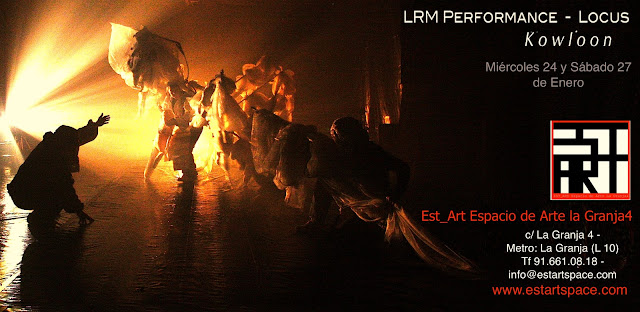
El 24 y 27 de Enero LRM–Locus estrenaremos en España Kowloon
en el espacio de Arte Est_Art, Madrid 


Kowloon es nuestra obra interdisciplinar abstracta de 56  minutos inspirada en aspectos de la cultura cantonesa


Kowloon, de LRM - Locus:  
¡Atención a los horarios que cambian dependiendo del día!

Miércoles 24 Enero – 20.00h

Sábado 27 de Enero – 19.00h 

Entrada gratuita hasta completar aforo. 


Recomendado para mayores de 14 años. 
No está permitido fotografiar ni grabar 

Estaremos encantados de contar con vuestra presencia


Ignacio Vleming Critique of Kowloon by LRM Locus


Ignacio Vleming 

Is editor and scriptwriter of art, culture and tourism videos with a degree in Art History and Audiovisual Communication from the Complutense university working as a journalist, cultural manager and community manager since 2004; worked with the  Spanish Ministry of Culture, 2 de Mayo Cultural Centre, National Museum of Romanticism, and Lázaro Galdiano Foundation. He is author of the poetry  book  “Clima artificial de primavera” (La Bella Varsovia, 2012) and he texts for the game-book “Inspiración Instantánea” (Modernito Books, 2013).

This text is his critique of our work, Kowloon, originally published in spanish in The Underdogs Magazine


KOWLOON, A MYSTERY TO BE PRESERVED

Under the title of Kowloon, the name of a peninsula that is part of Hong Kong and in which its Walled City was overcrowded with chinese exiles for decades, LRM Performance present their latest work: a piece heir to the best avant-garde theater with expressionist lighting and absence of dialogues.

Contrary to what is usually said about non-narrative proposals such as LRM Performance's, Kowloon uses rhythm and tempo with unheard-of exquisiteness, among other reasons because it relies on a solid formal structure –key to the success of any show and the very essence of beauty.

Although it may seem that another order is possible, the different scenes follow each other forming a homogeneous and harmonious whole, unalterable and closed as a universe that has no raison d'etre other than its contemplation. Way to go!


The sound environment, built up of volumes and weights belonging to architecture –areas of light and shade like those evoking the now-destroyed Walled City of Kowloon– generate an atmosphere from which mysterious characters emerge, ranging from the sinister to the tender or from disgusting to the sublime.

It could be said that we are in front of a moving landscape, with its changes in scale and intensity:  the smallest point of the horizon that grows as we approach to it until it becomes a huge cathedral behind which rosette lies nevertheless just a close-up of our own viscera.
I believe many directors and playwrights, even those who practice other kinds of theater –or rather those who do– could handle themselves more easily on stage if they followed the same guidelines that govern this piece.

The public should be asked to attend Kowloon as if they were to watch a firework display, a Ballet or a Mendelssohn concert, and ask no questions about what this play does or does not say. Questions that obviously have no answer, because true art creations conceal a mystery that must be preserved.

Ignacio Vleming, 2017

Kowloon - Silvia Santillana review and critique


"… A disturbing, magical, overwhelming staging, where the harmony of the parts becomes tangible in the eyes of the beholder through the movements, stillness and silences of its players, plus an impeccable technical apparatus, which acts as a catalyst for the most primary pulsations of the human being"


Esta es la traducción del artículo de Silvia Santillana sobre Kowloon,  de LRM Locus, publicado en Va de Arte – 

This is the English translation of the review of Kowloon by Silvia Santillana published at Va de Arte: 

Silvia Santillana is an Art Historian specialized on critique and cultural communication. She is editor at El Cultural (El Mundo newspaper) and at the digital plattform QAH Patrimonio.

Spanish version :


KOWLOON,  OR LRM LOCUS'  IMMERSIVE EXPERIENCE 

June 24, 2016


     When the lights go out, darkness overwhelms us, our senses sharpen up. An indescribable feeling surrounds us. A powerful impression lurks in the shadows. We do not know where we are or where we are going. Suddenly, a light constricts our pupils projecting us into an intense, imponderable glow wrappping up an illusory space full of lights and sounds. It's Kowloon (2015), the latest work from the LRM Performance (Locus) collective.


Kowloon is everything and nothing at the same time. A disturbing, magical, overwhelming staging in which the harmony of the parts becomes tangible in the eyes of the beholder through movements, stillness and silences of its players, plus an impeccable technical apparatus which acts as a catalyst for the most primary pulsations of the human being. There is something in Kowloon of a primeval state, of a chrysalis or an amphibian, a transitory state towards another something fleeing the anecdotal and connected to multiple underlying ideas. That idea, those traces of physical and eidetic experiences like frames of a movie or prefigured memories create a lattice, a hive of invertebrate creatures and indefinable shapes, escaping all logic and any categorization.


In Kowloon the idea of ​​the occult, of assembling images and materials compounds the essence of the creative process of this group formed by the performers David Aladro-Vico, composer, and Berta Delgado, visual artist, along with the guest movement performer for this piece, Chen Zhihan. A multidisciplinary work that shuns the traditional and present performance art trend of minimalist space and naked body.  Here, space is a labyrinth, an illusion, where the three performers may get lost, metamorphose, turn into hundreds, into one, or into none. A space that creates new perceptions with screens and mechanisms, revealing a pristine truth through its disguise,  one we can only access through art.


The idea of an ​​indefinable organism, which is cellular and mechanical at the same time is also present in this suffocating space inside the studio and in the beholder's mind; an immersive experience of 56 minutes and 22 scenes, which alludes to the Walled city of Kowloon (Hong Kong), demolished in 1994.

This fort created in the seventeenth century eventually became a Chinese enclave within British territory. Its structure began to grow after World War II, becomng a maze of buildings, one above the other, densely populated, a tangle of conducts, cables and pipes; a jumble of forms where sunlight barely penetrated. This phenomenon was documented in books and films, whose images remain in the memory through various cultural events such as Hong Kong cinema.


But above all, it is the spiritual atmosphere of Kowloon, through artificial lights and sounds, taken and altered from nature itself, which impresses us and puts us in touch with some eastern thought, not only from Hong Kong, but from different sources and locations. Thus Paprika anime film creator Satoshi Kon or master Lao Tse's basics of Taoist philosophy  seem to be present in Kowloon; a performance  disregarding no popular, current or traditional characteristics of Asian culture.

In that mélange of refined, frantic movements, endless lights and sounds, one also seems to contemplate the beginning of civilization itself, being part of the time when Prometheus stole fire from the gods to deliver his gift to mortals. With this action, the protagonist was punished to remain chained in an eternal torment and regeneration cycle which we cannot ignore in this LRM Locus' chaotic and mystical experience, making it clear their influences come not just from the Kowloon peninsula or Asia, but  from human beings and their emotions.


According to LRM Performance (Locus) collective's account :

"Our work seeks unmediated emotions, therefore expressly avoids narration by including the widest possible set of influences, carefully assembled to generate emotions instead of a thread or concept."


Thus, the "Anarchitecture" Gordon Matta-Clark or northern Finland's Onkalo nuclear repository  are just some of the images that make up the universe of Kowloon. In a mix of chance or fate, LRM Performance (Locus) studio is in Usera, the neighborhood with the highest number of chinese settlers from the Canton province in Madrid, along with many  other expatriates from around the world.

Traveling between the physical boundaries of the current political map we realize everything is possible within the human mind; Kowloon is proof of that. Any interpretation is free, and all creative work aims at giving wings to the imagination of the viewer; something LRM Performance -Locus not only achieved but exceeded, by referring us to a pure and chaotic state through the immersive experience of their toiled and wonderful work. "

Silvia Santillana 


Marie-Claire Decay (Museo Salvador Victoria) on LRM Performance / Locus

We had our presence at ARCO –Madrid's big contemporary Art Fair: Marie Claire Decay , president of the Salvador Victoria Foundation discussing on "Current validity of abstract Art" included us LRM Performance-Locus as "new trends in abstraction" 

Tuvimos nuestra presencia en ARCO - la gran feria de arte contemporáneo en Madrid: Marie Claire Decay, presidenta de honor de la Fundación Salvador Victoria incluyó a LRM Performance - Locus como "nuevas tendencias en abstracción" dentro de su conferencia "Vigencia del Arte Abstracto en 2017"


Marie Claire Decay on LRM Performance - ARCO 2017

Kowloon - El Estado Mental magazine - critique


This is the translation of the critique 
– almost an essay– on LRM Locus'  Kowloon, by Angel Alonso, 
published in the magazine El Estado Mental, aug 27th 2016

Esta es la crítica – casi un ensayo– de Angel Alonso sobre 
Kowloon de LRM Locus, 
recién publicado en la revista  El Estado Mental 
– puedes leerlo aquí


There is a backdrop

Kowloon, by LRM Performance-Locus
Angel Alonso


LRM Performance - Locus invited me few weeks ago to a private pass of their new work, entitled 'Kowloon'. I did not know what was I going to witness. I had only seen some photographs. In addition, members of LRM Locus  told me about their interest in Tsai Ming-liang, Roy Andersson, Andrei Tarkovsky, Apichatpong Weerasethakul or Fruit Chan's films. Perhaps that is why I began to wonder how invoking the cinematic memory within the transience of a performance would be. And it certainly stirred such visual memory, but in a much different way than I could have imagined.

Somehow, for this text I try to follow their work's game proposal and build up a non-narrative description of the piece. Therefore, in the following lines descriptions of specific moments of the piece are mixed with personal references to the world that  was stirred up in me when attempting to come back to Kowloon.


Before me, a closed drape. And behind it some sort of corridor. There has to be a wall at the end. But I cannot see it and I want to touch it, when suddenly comes to my mind a television image which may not exist but I want to remember: someone runs down a corridor which ending wall inescapably falls away.

I need to remember that image because I also need to touch what just appeared between the backdrop and that wall I feel moving away. But I can't, and because of it, I remember. Perhaps next time I may be able to touch that threatening, virginal and set adrift realm. Yes, perhaps the next step of LRM Locus will be allowing me to touch what I believe are sea creatures or arborescent crustacea. Or maybe they will allow me to caress and look carefully at it all when the lights come back on and Kowloon is gone. But I'm still in the darkness and I feel the sea so close inside the hall  that the sound of a door is like a ship about to wreck to me. Threatening worlds  you want to get closer to, a bit like what happened to David Drayton in The Mist (Frank Darabont, 2007), when he got out of a car and watched the solemn wandering gigantic creatures coming with mist from another world destroying anyone who dared in.

Kowloon seems also menacing, yet some drops dripping from it and a glimpse between its darkness make it more beautiful than sinister. Three body shaped drops walking around an ocean expelled as to pack it with walls, ratlines or sails to unfurl while the wind is being counted.

Those bodies also fear the sea and its creatures, they look at it downcast and in  quick glances,  discovering it in flashes of light. They may be inside an animal, as they  say Jonah was in a whale. Sometimes they touch the creature and the inside of her womb, or go to the remains of their wrecked barge.

One of them tapped a wall. Looks with its hands, not its eyes. And I feel the joy of hands sliding to touch, just for such joy, fear and faith they have when facing the unexplored, now that their eyes did not succeed in gazing and felt beaten from the distance by something unknown. Hands raised towards a new world, as if this quite determined item towards which we project [1] requests it, and they had to respond,  touching, to the call of the seemingly ignoble materials of Kowloon.

while hands are raining,
light hands, selfish hands, obscene hands,
waterfalls of hands that once were
flowers in the garden of a tiny pocket. [2]


Long time must have passed since I found them at the bottom of that ocean, for suddenly the flowers appear scattered over the body of one of the inhabitants of Kowloon. And the flowers are different, and also fossilized because, in a muddy cave on a remote system or at the bottom of the ocean, minutes are traveled as decades. Bodies that lost their human appearance in a liquid world –for the sea can do anything, as Ariel said to Ferdinand in The Tempest (William Shakespeare, 1611) with a ballad tone that always comes to me when a person is masked with plastics resembling lichens:

Full fathom five thy father lies; 
              Of his bones are coral made; 
    Those are pearls that were his eyes: 
              Nothing of him that doth fade, 
    But doth suffer a sea-change 
    Into something rich and strange. [3]

Then again, how long have they been in Kowloon so that their bodies changed? How much time did unfold before me while lights blink on and off? Did their bodies journey through the different ages of that world or did they simply create new galleries that take it away from me and it becomes strange again? Or maybe I did not even see the same bodies all the time and before me passed, generation after generation, all descendants of those three beings who arrived there one day.

I believe every slight flash of light showing me again that corridor which wall I still cannot gaze at, was enshrining all the Kowloons I once lived in as a traveler or watched on a screen. The experience of shutting and opening your eyes -of interrupted lights - placed me beyond any chronology and yet, allowed me to remember all the stories and lives I inadvertently wished for. It was only a fifty minute trip and escape. While that piece of Hong Kong made me open my eyes to shut them out immediately, the experienced sensation of light taking place at a given time was the condensation of an extraordinarily incomprehensible story, which unfolded in a stumbling world I could only snatch a wisp from.

There lie, succeeding each other, trillions of oscillations, that is, a series of events such that if I wanted to count them, even with the greatest possible economy of time, would require thousands of years. [4]


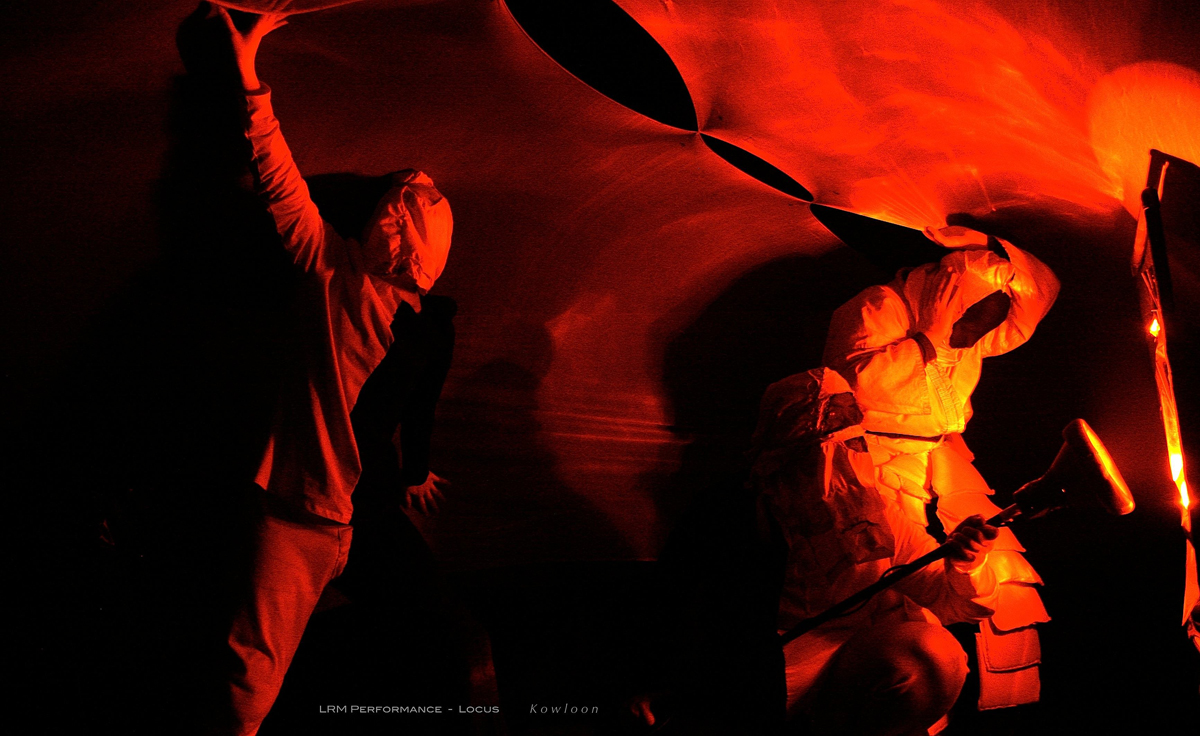
Images from Kowloon, by LRM performance–Locus, (2016) 
and The Mist (Frank Darabont, 2007)


[1]  Merleau-Ponty, Maurice, Phénoménologie de la Perceptión (1945)

[2] Cernuda, Luis,  Qué ruido tan triste (1931)

[3] Shakespeare, William,  The Tempest (1611), Ariel's  Song

[4] Bergson, Henri, L'Énergie spirituelle (1919)

Kowloon - El Estado Mental magazine - critique


This is the translation of the critique 
– almost an essay– on LRM Locus'  Kowloon, by Angel Alonso, 
published in the magazine El Estado Mental, aug 27th 2016


There is a backdrop

Kowloon, by LRM Performance-Locus
Angel Alonso


LRM Performance - Locus invited me few weeks ago to a private pass of their new work, entitled 'Kowloon'. I did not know what was I going to witness. I had only seen some photographs. In addition, members of LRM Locus  told me about their interest in Tsai Ming-liang, Roy Andersson, Andrei Tarkovsky, Apichatpong Weerasethakul or Fruit Chan's films. Perhaps that is why I began to wonder how invoking the cinematic memory within the transience of a performance would be. And it certainly stirred such visual memory, but in a much different way than I could have imagined.

Somehow, for this text I try to follow their work's game proposal and build up a non-narrative description of the piece. Therefore, in the following lines descriptions of specific moments of the piece are mixed with personal references to the world that  was stirred up in me when attempting to come back to Kowloon.


Before me, a closed drape. And behind it some sort of corridor. There has to be a wall at the end. But I cannot see it and I want to touch it, when suddenly comes to my mind a television image which may not exist but I want to remember: someone runs down a corridor which ending wall inescapably falls away.

I need to remember that image because I also need to touch what just appeared between the backdrop and that wall I feel moving away. But I can't, and because of it, I remember. Perhaps next time I may be able to touch that threatening, virginal and set adrift realm. Yes, perhaps the next step of LRM Locus will be allowing me to touch what I believe are sea creatures or arborescent crustacea. Or maybe they will allow me to caress and look carefully at it all when the lights come back on and Kowloon is gone. But I'm still in the darkness and I feel the sea so close inside the hall  that the sound of a door is like a ship about to wreck to me. Threatening worlds  you want to get closer to, a bit like what happened to David Drayton in The Mist (Frank Darabont, 2007), when he got out of a car and watched the solemn wandering gigantic creatures coming with mist from another world destroying anyone who dared in.

Kowloon seems also menacing, yet some drops dripping from it and a glimpse between its darkness make it more beautiful than sinister. Three body shaped drops walking around an ocean expelled as to pack it with walls, ratlines or sails to unfurl while the wind is being counted.

Those bodies also fear the sea and its creatures, they look at it downcast and in  quick glances,  discovering it in flashes of light. They may be inside an animal, as they  say Jonah was in a whale. Sometimes they touch the creature and the inside of her womb, or go to the remains of their wrecked barge.

One of them tapped a wall. Looks with its hands, not its eyes. And I feel the joy of hands sliding to touch, just for such joy, fear and faith they have when facing the unexplored, now that their eyes did not succeed in gazing and felt beaten from the distance by something unknown. Hands raised towards a new world, as if this quite determined item towards which we project [1] requests it, and they had to respond,  touching, to the call of the seemingly ignoble materials of Kowloon.

while hands are raining,
light hands, selfish hands, obscene hands,
waterfalls of hands that once were
flowers in the garden of a tiny pocket. [2]


Long time must have passed since I found them at the bottom of that ocean, for suddenly the flowers appear scattered over the body of one of the inhabitants of Kowloon. And the flowers are different, and also fossilized because, in a muddy cave on a remote system or at the bottom of the ocean, minutes are traveled as decades. Bodies that lost their human appearance in a liquid world –for the sea can do anything, as Ariel said to Ferdinand in The Tempest (William Shakespeare, 1611) with a ballad tone that always comes to me when a person is masked with plastics resembling lichens:

Full fathom five thy father lies; 
              Of his bones are coral made; 
    Those are pearls that were his eyes: 
              Nothing of him that doth fade, 
    But doth suffer a sea-change 
    Into something rich and strange. [3]

Then again, how long have they been in Kowloon so that their bodies changed? How much time did unfold before me while lights blink on and off? Did their bodies journey through the different ages of that world or did they simply create new galleries that take it away from me and it becomes strange again? Or maybe I did not even see the same bodies all the time and before me passed, generation after generation, all descendants of those three beings who arrived there one day.

I believe every slight flash of light showing me again that corridor which wall I still cannot gaze at, was enshrining all the Kowloons I once lived in as a traveler or watched on a screen. The experience of shutting and opening your eyes -of interrupted lights - placed me beyond any chronology and yet, allowed me to remember all the stories and lives I inadvertently wished for. It was only a fifty minute trip and escape. While that piece of Hong Kong made me open my eyes to shut them out immediately, the experienced sensation of light taking place at a given time was the condensation of an extraordinarily incomprehensible story, which unfolded in a stumbling world I could only snatch a wisp from.

There lie, succeeding each other, trillions of oscillations, that is, a series of events such that if I wanted to count them, even with the greatest possible economy of time, would require thousands of years. [4]


Images from Kowloon, by LRM performance–Locus, (2016) 
and The Mist (Frank Darabont, 2007)


[1]  Merleau-Ponty, Maurice, Phénoménologie de la Perceptión (1945)

[2] Cernuda, Luis,  Qué ruido tan triste (1931)

[3] Shakespeare, William,  The Tempest (1611), Ariel's  Song

[4] Bergson, Henri, L'Énergie spirituelle (1919)

Kowloon: Fabio Zannoni - Crítica / Critique

     Crítica de Kowloon para la revista Rumor(s)cena, por Fabio Zanonni, crítico de música contemporánea

    Critique of "Kowloon" by Fabio Zanonni, contemporary music critic for  Rumor(s)cena magazine - english translation below


Kowloon: cuando lo que produce sentido es la materia escénica


     No es fácil definir el sentido de una acción escénica que deliberadamente se presenta como asemántica, cuya ejecución procede como materia teatral, sonora o luminosa y se autogenera sin programa narrativo. 

La obra “Kowloon”, de LRM Locus, aunque escapa a cualquier tentativa clasificatoria (happening o performance nos parecen términos ya obsoletos) y evita cuidadosamente recurrir a contenidos específicos, despliega una enorme capacidad para urdir tramas, para definir atmósferas nítidas y dimensiones emocionales de conflicto, opresión o extravío, e incluso para construir relatos. Erige de este modo un laberinto de sugerencias, dentro del cual el espectador es libre de elegir su personal itinerario interpretativo y de reconstruir la variedad de sensaciones visuales y sonoras que se acumulan, con ritmos alternos, durante la presentación. 

Con este fin se utiliza de manera magistral la oscuridad, en la que aparecen, primero confusamente y después con más claridad los contornos de de los seres de este mundo/planeta. De ahí emergen también haces y desgarros lumínicos, luces rojas, anaranjadas, azules…

La visión queda así marcada por esta dialéctica de luz y oscuridad, al igual que la percepción sonora lo está por la del silencio y el sonido. Una sonoridad entreverada de estruendos, rumores, ecos concretos provenientes de la cotidianidad y la electrónica. 

De este modo, el ambiente en el que se mueven los tres personajes alterna momentos de vacío con otros en los que se crean, mediante telas constantemente en movimiento, ámbitos vagamente opresivos, pasadizos, grutas … 

Más adelante, juegos de velos movidos por maquinarias teatrales artesanales, junto a proyecciones sobre una pantalla de tul de mecanismos aleatorios con objetos que se mueven en una cajita: el deseo de asombrar, con la fascinación de numerosos estímulos, revela un gusto casi barroco

Si, por un lado, se nos propone una materia escénica pura (el juego combinatorio de luces, movimientos, sonidos…), por el otro lado, el del público, toma cuerpo la urdimbre de una compleja búsqueda de sentido, o de una laberíntica heterogeneidad de sentidos: atmósferas post-atómicas, y una velada percepción de la angustia y la opresión, de la búsqueda de una vida en una situación densa de incertidumbre…

Con una partitura nítidamente definida, la indeterminación y el azar  irrumpen en la escena, y constituyen la clave de un proyecto muy riguroso; en ellas reside a nuestro parecer el hilo interpretativo de un laberinto de historias posibles, que permanecen en el fondo, como horizonte. 

En definitiva, un proyecto que confirma de manera decisa la prioridad superlativa de la propuesta artesanal y material, de la acción y la ejecución de la materia escenográfica como algo que se presenta como dotado de vida propia.

No dejan de insinuarse otros elementos para la reflexión; el escenario de Kowloon genera una apertura sistemática de posibilidades para realizar hallazgos inéditos. Esta constituye sin duda la gran fuerza y el encanto enigmático de esta obra.
Fabio Zannoni

Original en italiano en Rumor(s)cena magazine


Kowloon:  when the staged matter is what generates sense

   It is not easy to define the meaning of a scenic action that intentionally stands as non-semantic, which performance proceeds as self-generating stage-sound-light matter without any narrative program. 

The piece "Kowloon" by LRM Locus, while escaping to any genre cataloging –happening or performance art seem obsolete terms already– and carefully avoiding to build-up any specific content,  unfolds at the same time an enormous capacity for weaving textures, defining precise atmospheres, emotional dimensions of conflict, oppression or loss, and even creating stories. It 'a labyrinth of suggestions in which the viewer is left  free to create a personal journey of interpretation and put together a variety of visual and sound sensations that pile up in alternate rhythms through the unfolding of the representation. 

There is a superb usage of darkness, from which shapes of the beings of this world / planet emerge, first indistinct, then gradually more defined; also, luminiferous beams and gashes of bright, red, orange, blue lights. The vision is thus regulated by this dialectic of light and dark, and sound reception from that of silence and sound; sounds made up of clanging, hissing, concrete echoes from the quotidian and electronics. 

So the environment in which the three characters move alternates moments of emptiness with others in which through constantly moving fabrics more or less oppressive environments, tunnels, caverns  surge up…

Further on, sets of veils operated by artisanal theatrical machinery and projections on a tulle of random mechanisms of rotating objects in a box: The desire of impressing, the fascination of constant stimuli reveal an almost baroque intention. 

If, on the one hand, a pure scenic matter is proposed - a combinatorial game of lights, movements, sounds - on the other, that of the public, it outlines the lattice of a complex search for meaning or a labyrinthine plurivocity of senses: post-atomic atmospheres, a veiled sense of fear and oppression, of the search for life in a dense state of uncertainty ...

With a precisely defined musical score, indeterminacy and randomness burst into the scene and become the key to a rigorous project, in our opinion it is right there where the interpretative thread of a maze of possible stories lies, which remain in the background as a horizon. 

Definitely a project that ultimately establishes the superlative priority of the artisanal and material data, of action and performing of scenographical matter displayed as having a life of its own.

Other elements for reflection keep coming up; Kowloon scenery generates a systematic disclosure of further possibilities for unheard-of findings.  
Without a doubt  this is the greatest  strength and enigmatic charm of this piece.

Fabio Zannoni

published in italian in Rumor(s)cena magazine 

LRM participa en el debate "La performance y lo performático"


LRM / Locus participará este miércoles en el debate La performance y lo performático junto a los artistas Juan Yuste, Patricia Landabaso, José A. Vallejo, Óscar Pastor y moderado por Nuria García. Este evento está organizado por VeoArte y se enmarca dentro de la Semana Grande de Lanau Espacio Creativo.

El evento podrá seguirse por streaming desde Periscope
También podrá seguirse con el hashtag #arteyuncafe en Twitter

La performance y lo performático
Miércoles 9 de diciembre, 19:00 h
Lanau Espacio Creativo

Este es el texto que aportamos sobre el tema.


Una salida hacia adelante 
Por David Aladro-Vico y Berta Delgado – LRM Performance-Locus

Performance, performativo, performancístico, performática, performancear... ¿LA performance? ¿EL performance? ¿es un...o una...performance? Performance, según el diccionario de Oxford significa "Interpretación" o "Ejecución", "Llevar a cabo una acción". Para algunos, a veces, simplemente "Acción". En el contexto artístico, "Performance art" según Oxford es: "An art form that combines visual art with dramatic performance"  Dramático, a su vez se puede referir al arte dramático, lo que se conoce coloquialmente como Teatro. 
En ese caso se trataría de una combinación de elementos preexistentes. Pero sus adeptos definen como una forma de arte de creación actual, incluso del futuro, pues rompe radicalmente con el pasado, así que no me queda claro si hay ejemplos del XIX o anteriores. Quizá se basan en una percepción concreta de la historia o del tiempo, como lo son todas.
Sí, es verdad que en muchos casos esta forma de arte me parece dramática – en todas sus acepciones– incluso trágica, seria como la neumonía, o patética o hasta peripatética y melodramática. En ese caso, performance sí podría tener alguna relación con el siglo XIX, el romanticismo y como decía C. J.  Cela, su "falta de higiene mental".  

Pero ahí Wikipedia, taxonomista superstar, me avisa de la ambigüedad del término Performance, y zanja la cuestión:  Not to be confused with Performing arts.

También dice Oxford: "an art form in which an artist gives a performance, rather than producing a physical work of art" – un artista ejecuta una acción, antes que producir una obra de arte "física". Según esta definición, una acción no pertenece al mundo físico, sino a otro que no es explicado, lo mental o lo etéreo, a veces llamado conceptual. Pero yo no comparto esas divisiones dualistas entre un mundo físico y otro mental, conceptual o etéreo.  

Y me sigue sin estar claro qué es performance, pero los esfuerzos taxonomistas por tener clara y cerrada su definición son cada vez más abundantes y perseverantes. Respaldan y vigilan esa labor taxonómica mediante etimología, historiografía, sociología...  todo esfuerzo es bienvenido en la incansable labor taxonómica del hombre occidental. Porque es importante investir a tu término de poderes sobrenaturales, eternos e indiscutibles, como son la Historia con mayúsculas o el consenso social. There's safety in numbers, sean años, lugares o personas. 

Me parece que la taxonomía es a la creatividad lo que la taxidermia a los seres vivos. Con razón decía un profesor mío que los diccionarios son cementerios de metáforas. El arte y la metáfora suelen tener cosas en común: su significado no es literal, por lo que no puede ser definido sin su contexto; un objeto o acción se convierte temporalmente en símbolo o representación de otro objeto o acción. Es importante esto de temporal y contextualmente; en el momento en que el significado se cierra, deja de ser temporal y contextual, deja de ser una metáfora para ser una definición. 

Pero yo quiero ir más allá, creo que la función del arte NO es transmitir significado. Para eso ya está el lenguaje, que hace lo que puede. Y además, creo que el arte no debe ser interpretado, porque perderá su efecto y razón de ser, como decía Susan Sontag. Que la metáfora no debe ser explicada porque acabará descansando en paz  en un diccionario, o en Wikipedia. 

Los taxonomistas, cuya labor es evitar que se cuestionen las cosas, se empiezan a poner verdaderamente nerviosos con esto. Su trabajo es fijar aquello que es temporal,  y darle armas, defenderlo – y así se encuentran entregados a la definición, (etimológicamente, poner un fin) la codificación, clasificación, organización, disposición, catalogación, sistematización, y todos sus sinónimos y sus relaciones (incluyendo comisariado, por supuesto). Y como dije antes, a su vigilancia: están y siempre han estado dispuestos a perseverar. De hecho, recuerdo haber leído en alguna parte, "La política postmoderna es una contienda por la percepción y sus reglas". Creo que esa guerra surgió mucho antes de la postmodernidad, aunque quizá se ha acentuado desde el siglo XX. 

La poderosa Historia está pues repleta de ejemplos de cánones establecidos, reforzados, desafiados y derribados y vueltos a recuperar y vueltos a derribar. Hay todo un entorno profesional, una industria tanto alrededor de los que hablan sobre ellos como de los que elaboran arte del que derivar los cánones.
Son mundos muy competitivos. Tienen la idea de que sólo puede quedar uno y deben cortarse la cabeza unos a otros. De hecho, la labor taxonómica resultante suele reflejarlo: tienen tendencia a unificar lo plural y pluralizar lo único, para poder acotar bien sus definiciones. En un acto de reduccionismo radical de la realidad, escogen a un artista (de performance, ya que estamos) y hacen que sea el ejemplo único, y el canon extraído de ese ejemplo se impone a todos los demás, artistas o pensadores, excluyendo los que no encajen. Mediante la Katana, si hace falta. 

Me parece algo obvio, pero muy a menudo es necesario recordar la diferencia entre copiar y crear. Toda labor creativa (sea en arte, ciencia o cualquier actividad) pasa obligatoriamente por cuestionar en alguna medida los cánones, estéticos o perceptivos en general. Ser taxonómico no es el objetivo, ni integrarse en una visión concreta de la actividad artística, más bien al revés, así que disculpen si hay gente creativa también dispuesta a perseverar. 

Bueno, pero por encima esas pugnas recordemos que tanto al tratar con arte o crearlo (o cualquier otra actividad) no es aceptable entrar en el terreno de la psicopatía – entiéndase el término como la falta de capacidad de empatía o remordimientos, sociopatía, o indiferencia o desprecio por los demás. Esta característica psicológica es habitual en ambientes profesionales muy competitivos como por ejemplo la política, Wall Street o el ambiente de los de artistas y comisarios famosos. Con Katana o sin ella. 


Hace tiempo me fijé en un texto de Alan Kaprow,  How to make a Happening de 1966. (Por cierto que "Happening" "Intermedia" y otras  eran palabras relacionadas con performance, pero que la taxonomía ha domesticado) En el texto, Kaprow define su cánon estético exponiendo once puntos. Como todos los cánones, define lo que se debe hacer como de lo que no se debe, explícitamente o no. 
Creo que  contiene muchos criterios observables en el tratamiento por parte de la prensa e instituciones profesionales del arte actuales sobre  performance. 

Definir una posición artística no es habitual ni tiene por qué serlo en un artista; puede trabajar sin explicar su método ni principios –este sector se dedica a la manufactura, y explicar o definir es más labor obligada del otro sector. Pero piense en la libertad que esto da para elaborar explicaciones adecuadas al objetivo del taxonomista, que no tiene porqué ser el mismo que el del artista. Aunque a menudo el artista acaba haciendo de todo, elaboración, marketing y hasta merchandising


Ya han pasado casi cincuenta años desde aquel texto, y más aun de lo que se considera el orígen del performance art. Así pues, puedo considerar que sus ideas han pasado sobradamente por el filtro taxonómico, y están ya bien definidas y listas para descansar en paz en Wikipedia o en más ilustres panteones. 

Nuestro trabajo como colectivo artístico se desarrolla en el mundo de la manufactura, no de la taxonomía, pero como decía, dado que la situación lo requiere, hemos elaborado un texto similar al de Kaprow. Entiéndase bien que no tenemos ningún problema con la obra de Kaprow ni de ninguno de sus contemporáneos, podemos disfrutar de ella y de la de muchos otros artistas que responden a sus principios, sin que eso suponga que los compartamos ni que queramos eliminarlos. Así pues, con todo respeto, simplemente para continuar aportando a la tradición de romper con la tradición, hemos observado que bastaba con revertir los principios expresados por Kaprow para generar unos más acordes con nuestra época y forma de pensar. 

De esta manera, estos serían nuestros principios:

1) Happening, o performance y similares ya son formas estándar. Así pues, puedo olvidarme de ellas, o mejor, olvidarme de la propuesta de olvidar las formas estándar, como ya son las de Kaprow y otros artistas de performance. (En realidad, ésa ya era una idea de la postmodernidad  de hace más de veinticinco años).

2) Separa bien lo que es arte de lo que es vida real, pues mezclar arte y vida real para "salir del arte", que la barrera entre arte o vida real sea difusa ya es parte habitual del mundo del arte

3) Utiliza tu imaginación para crear. No te distraigas con el exterior. Si te atienes demasiado a lo real y usas situaciones reales o readymade, volverás al arte preexistente. No utilices la realidad. Elabora. Rechaza lo arbitrario. 

4) Utiliza un espacio concreto, bien definido y determinado. Rechaza usar cualquier espacio, especialmente los públicos o improvisados, y los muy grandes. No sirve cualquier lugar ni de cualquier tamaño, eso ya se ha hecho antes. 

5) Rechaza el tiempo real. Puedes y debes manipular el tiempo, porque no pertenece a la realidad. Coordina lo que haces. Controla el tiempo, sácalo de la realidad. Ajusta la acción a tu tiempo controlando ambos. Dejar la duración al azar o a la conveniencia de la acción realizada ya se ha hecho antes. 

6) Dispón los eventos de tu obra de la misma manera, coordina y controla el contenido. Adapta las cosas a lo que quieres, no al revés. Planifica, aunque cierta escolástica de composición de  performance  te diga que es mejor no hacerlo – el elemento sorpresa sólo vendrá cuando las cosas estén bajo control

7) Como estás haciendo un trabajo y no cualquier cosa, tú creas las reglas. No dejes que el entorno decida lo que puedes o no puedes hacer. El entorno es precisamente lo que tú has de crear, y no dejar ese trabajo a la realidad. 

8) No trabajes para los poderes que tienes alrededor, no te harán las cosas más fáciles. No esperes su aprobación, pues no es simplemente hacer cosas lo que buscas. No seas oportunista ni advenedizo, ni creas que eso te llevará al fin del mundo.

9) Practica y haz pruebas y ensayos, repite. No repetir ya se ha hecho, y te hace creer que no hay nada que mejorar. Busca estudiar y practicar, es la única manera de ser natural. No existen trucos ni atajos, hay que trabajar las cosas para que parezcan naturales, hechas sin esfuerzo. 


10) Presenta varias veces tu obra, serializa. No repetirla la hace vulgar, irrelevante, o presuntuosa y frívola, como es la  performance que ya se ha hecho. No repetir te hace creer que es perfecta y que eres un genio. Tu misión es repetir precisamente aquello que parece imposible que se vuelva a dar.  

11) No tengas problema en que lo que haces sea un espectáculo para un públicoUna performance ES un espectáculo, en contra de lo que los libros te dicen, no hay diferencia entre performance y el teatro o concierto: lo que buscas es que sea visto y crear un efecto en la audiencia. No estas jugando, ni haciendo actividades al azar o pueriles, ni rituales pseudo-religiosos que aspiran a ser intelectualmente de "mayor altura". No te aproveches de alguien que no es una audiencia diciendo que les vas a implicar, o que va a interactuar, es un truco muy usado ya.  


Por último, y como añadido a estos puntos, comentar que para el taxonomista del performance art, la palabra espectáculo define por antítesis la posición política del artista de performance,  que rechaza "venderse" o contribuir a la alienación que produce el arte tradicional o el de masas. Basado en una posición política coetánea a la de Kaprow expresada en textos como La sociedad del espectáculo de Guy Debord o de la Internacional Situacionista, o también en  la posición de Deleuze y Guattari, nos parece que esa posición política corresponde a una realidad de hace cincuenta años y que en 2015 no sólo no ha lugar por carecer de efectividad política en la dirección que ellos dicen tener, sino que sirve al pensamiento contra el que dice oponerse, el del capitalismo –como señala por ejemplo Slavoj Žižek, y aunque pretendan lo contrario, está completamente asumida – alienada–por una economía de mercado y resignada a ello. Y además, muy lejos de la actitud de los años 60, se ha vuelto intolerante con el pluralismo, sea político o artístico. 
Propongamos pues, una salida hacia adelante. 

LRM Performance- Locus, Diciembre 2015